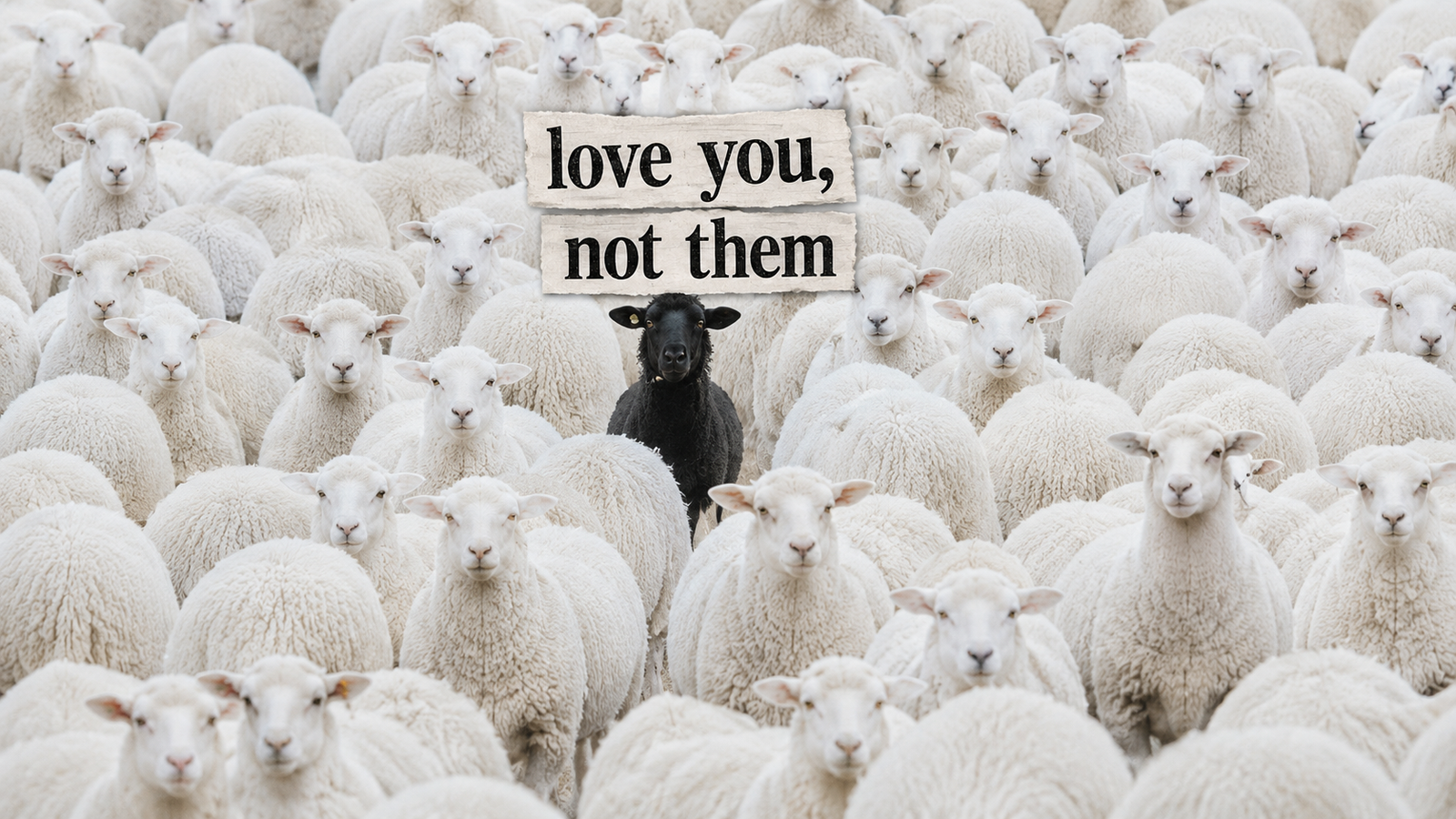
I never understood why anyone would choose to be racist or xenophobic when they could simply hate people instead. After all, most people are idiots who do stupid things. Plenty of them spit under people’s windows, no matter what country you’re in or what nationality they happen to be. Or rather, we do. Because I don’t know about you, but I, for one, manage to be an idiot about something every single day, and every single day I inevitably do at least one stupid thing. I don’t spit under people’s windows, though, to be fair. But maybe that’s just me.
Still, today I’d like to invite you into the magical world of misanthropy, where people can truly unite in their mutual dislike without getting distracted by trivial differences.
Because what I love most about misanthropy is its inclusiveness. That’s our real common ground — not some illusion of universal love. Misanthropy couldn’t care less what color your skin is, what nationality you are, what religion you follow, or what your sexual orientation happens to be. But if you’re an idiot — welcome.
Зміст
The Tribe Against Humanity
So, humanity. The cause of wars, dictatorships, genocides, and corruption; the world’s sole producer of phone scammers, neighbours with power drills at seven in the morning, people who watch TikToks on full volume on the bus, and those who never clean up after their dogs. And then one eight-billionth of this very humanity looks at all of that and suddenly arrives at a completely unexpected conclusion: “It’s all those damn immigrants / Muslims / Jews / Roma / Ukrainians / Americans / gay people / drug addicts / Trojans / dead roosters / insert your preferred scapegoat here.” That’s it. The source of all our problems has been found, and all that pent-up bile has finally been given somewhere to go.
And yet, somehow, everywhere I’ve been I’ve met both wonderful people and complete idiots among the locals. Why is fraud, cruelty, indifference, envy, and the inability to carry a trash bag all the way to the dumpster found in every corner of the world, regardless of the dominant religion, skin color, or national cuisine? It seems stupidity is distributed across the planet with remarkable equality.
And yet hating everyone is difficult, because doing so would require admitting that the problem has no particular face, no particular name, and no particular passport; that human beings are contradictory creatures, capable of saving a stranger’s life today and parking across the sidewalk tomorrow so every parent with a stroller has to walk around them. It’s much easier to pick one group, declare it the source of civilization’s decline, and regain the comforting illusion that the world finally makes sense again.
Why Are We So Obsessed with Boxes?
In my first year of studying intercultural communication, I came across one way of describing how societies understand culture and how different groups of people live together. The first model is called monoculturality — something straight out of the good old Aristotelian tradition, where everything has to be sorted into neat little boxes and labeled accordingly. The only problem is that people tend to find boxes rather cramped.
Monoculturality
Monoculturality starts from the assumption that there is one right culture, one right identity, and one right way of belonging. It sounds harmless enough — after all, who could possibly be against culture, tradition, and a sense of belonging? The trouble begins with one particular word: real. A real Ukrainian, a real woman, a real human being…
Because once “real” people exist, someone else inevitably becomes not quite real enough. This person has an accent. That one follows the wrong religion. Someone else has the wrong skin color. She dresses the wrong way. He ate the wrong thing, said the wrong thing, or simply gave you a suspicious look. Before long, this endless parade of “not quite right” starts to feel like a threat to what is supposedly real, as though another person’s language, hairstyle, or habits could somehow damage your identity simply by existing.
That’s why monocultural thinking so easily turns into the politics of us versus them. There is one proper tribe that supposedly embodies the authentic nation, and then there is everyone else — those who don’t fit in, don’t fit in well enough, or, worst of all, refuse to accept that this tribe has the right to define the rules for everybody else.
Trumpism and Brexit
One of the central mechanisms of Nazi ideology was the creation of the image of a homogeneous “real people.” First, the regime decided who belonged to that people. Then it identified those who supposedly contaminated it, weakened it, or betrayed it. Once that was done, persecuting the excluded could be presented not as violence, but as protection.
The same mechanism — though obviously not to the same extent — can be found in today’s far-right movements, in Trumpism with its promise to restore some vaguely defined “real America,” and in the Brexit narrative that Britain would somehow become itself again once it “took back control” from foreigners and over its borders. Spoiler: it didn’t. Mostly because there is no such thing as the one “real Britain” in the first place.
China
Authoritarian leaders also find this logic remarkably useful. Once a nation is imagined as a single organism with one culture, one historical destiny, and one legitimate voice, political diversity can easily be portrayed as division, while an unchanging leader becomes the guarantor of national unity.
In China, this logic helps legitimize the concentration of power. If there is only one correct path for the country’s development and only one political party capable of leading it, then political competition can be framed not as a normal feature of public life but as a threat to unity and stability.
In 2018, China removed the constitutional two-term limit for the offices of president and vice president, effectively allowing Xi Jinping to remain president for more than ten years. That decision was not a direct consequence of monocultural thinking, but the rhetoric of unity, stability, and a single correct national course helps justify such a concentration of power.
Muscovy
This logic reaches an especially sophisticated form in Muscovy, where an essentialist understanding of culture merges with imperial thinking. The state can acknowledge the existence of many different peoples — as long as they all revolve around Moscow and do not claim an independent political will.
From this perspective, Ukraine is not simply a neighboring country with a different culture but part of a supposedly unified historical and spiritual space that has inexplicably decided to show off, refusing to remain part of the “real” community and behaving as though it had a will of its own. Clearly, order must be restored, because this refusal itself is seen as a threat — not to actual people, but to a worldview in which Muscovy stands at the center and everyone else is expected to know their place.
In this framework, culture no longer describes people’s lives; it becomes a cage. Once you’ve been declared part of a single people, disagreement ceases to be a political position and turns into a disease, a betrayal, or the result of foreign manipulation.
That is precisely why an essentialist understanding of identity — the belief that every nation possesses some permanent, unchanging essence — is so useful to Muscovy. It allows the state to deny a reality in which cultures evolve, people choose their own identities, and neighboring nations are under no obligation to play the roles written for them in Moscow.
Four Ways of Living Together
Multiculturality
The second model is multiculturality, which says: all right, let’s have many cultures. That alone is already a huge step forward, because at least differences no longer have to be eradicated, forbidden, or pretended away. But there’s a catch.
In its most passive form, multiculturality resembles an apartment building where everyone lives side by side, nobody particularly bothers anyone else, everyone is perfectly polite, and yet hardly anyone actually knows their neighbors. Ukrainians hang out with Ukrainians, Turks with Turks, Chinese with Chinese, Swedes with Swedes. Each community has its own shops, holidays, civic organizations, gathering places, and perhaps a vague idea of what the neighbors are like, but these worlds exist largely in parallel.
This isn’t necessarily a bad thing. Being able to preserve your language, traditions, and community without being forced to assimilate is an important achievement. The problem arises when “respect for differences” means that people share virtually no common space, have little influence on one another, and can spend decades living in the same city while remaining complete strangers. Multiculturality says, “You have the right to be yourself.” But it doesn’t necessarily ask, “How do we become a society together?”
Interculturality
The third model is interculturality, which asks exactly that: What if we actually got to know each other?
Here, cultures don’t merely tolerate one another or politely coexist on opposite sides of the hallway. They interact. They argue. They fall in love. They work together. They translate jokes for one another, borrow words, recipes, traditions, and ideas, and sometimes even admit that someone else’s way of doing things isn’t automatically ridiculous simply because it isn’t their own.
Interculturality requires dialogue — but not the sterile kind where everyone sits in a circle, smiles politely, and solemnly declares that diversity is our strength. Real interaction means being willing not only to show others your culture but also to let them ask uncomfortable questions, disagree with you, reshape shared rules, and, every now and then, change you as well. It is no longer simply “We allow you to exist.” It becomes “Your presence matters because it changes who we all become.”
Even here, however, cultures are still imagined as more or less separate entities: here’s Ukrainian culture, here’s Swedish culture, here’s Syrian culture, and now they’re all sitting around the same table trying to get along without arguing over who ruined the borshch.
Transculturality
The fourth model, transculturality, looks at that table and asks: Are you really sure everyone here arrived carrying exactly one complete culture in a neatly labeled container?
The Transcultural Melting Pot
Take me, for example. After living in three other countries, I now live in Sweden. I write and think in Ukrainian and English. I study at a Swedish university. Today I cooked Palestinian chicken; yesterday it was Mexican tacos. I read authors from all over the world in several languages, listen to an eclectic mix of music, I’m writing a book, and I’m raising a child who is growing up in a cultural environment completely different from the one I grew up in. Which of these cultures is mine?
All of them — and none of them on their own.
Transculturality differs from multiculturality and interculturality in that it doesn’t see cultures as neatly packaged boxes that first exist independently and then either stand politely side by side or start talking to one another. Instead, it says the boxes have been leaking for a very long time. People are constantly carrying things from one to another, and many of us have grown up inside several cultural worlds at once, making it impossible to divide ourselves neatly into national compartments.
The Myth of Cultural Purity
If you take an honest look at your own life, you’ll probably find much the same thing. Perhaps you use an American phone assembled from components made in several countries, drive a Japanese car, listen to French music, eat Italian pizza, drink coffee whose story stretches from Ethiopia through Yemen and the Ottoman Empire to the rest of the world, read Spanish authors, watch Danish series, and work for an international company where you speak a language that itself has been shaped by centuries of migration, conquest, and cultural borrowing.
Of course, owning a foreign phone or loving Italian pizza doesn’t make anyone transcultural by itself. But it does reveal just how artificial the idea of completely self-contained, hermetically sealed cultures really is. So where does one culture end and another begin?
Nowhere, really. The boundary exists mostly in the minds of people who desperately need to sort everything into tidy little boxes.
Transculturality simply acknowledges what has always been true: human cultures have never been hermetically sealed. For thousands of years, they have traded, fought, fallen in love, migrated, stolen from one another, translated each other’s books, borrowed recipes, words, melodies, technologies — even gods — and then solemnly declared the result an ancient national tradition.
That’s why the phrase “protecting the purity of a culture” strikes me as so absurd. Which culture, exactly? The one that has been constantly changing for thousands of years? The one where countless “native” words originally came from somewhere else, where the beloved national dish arrived from abroad, and where traditional clothing owes its existence to trade, empires, technological innovation, and the simple fact that, at some point, somebody liked someone else’s button?
Of course, cultures can — and should — be protected from destruction, prohibition, Russification, colonization, and appropriation. But that is not the same thing as protecting them from change and human contact. A living culture changes precisely because the people who carry it are alive. A culture that has been perfectly purified, preserved forever, and shielded from every outside influence has another name: a museum exhibit.
A Misanthrope’s Manifesto
And so, at last, I’ve found the answer. Misanthropy is the most democratic form of disappointment in humanity and all its complexities, because it doesn’t force us to invent specific enemies or explain every problem by blaming a single group of people.
It simply says: Friends, the problem isn’t Arabs, or Ukrainians, or Chinese people, or Americans, or even gay people. The problem is that we’re all human. And human beings, regardless of where they come from, possess the extraordinary ability to be kind, brave, and compassionate — only to behave like complete idiots five minutes later.
That’s what truly unites us. That’s where our common ground lies: in our universal, transcultural, and thoroughly international ability to do something spectacularly stupid every now and then, and then convince ourselves that somebody else — preferably a foreigner with suspicious food and an unfamiliar accent — is to blame.
So I’d like to suggest that we stop sweating the small stuff and stop building our identities around whoever we’ve decided to exclude from the category of the “real” today. If we’re going to unite, let’s unite on the one foundation that genuinely belongs to all of us, regardless of nationality, religion, language, skin color, or how we make our borshch.
Ladies and gentlemen,
let’s hate. We’re all idiots.