Vaccines are one of those topics that somehow manage to trigger arguments everywhere: in parenting groups, family chats, comment sections, and waiting rooms. Some people are convinced vaccines are a miracle of modern medicine. Others are convinced they are a conspiracy designed to poison humanity. Most parents, meanwhile, are simply trying to figure out what is actually true while being bombarded with conflicting information from all sides.
The irony is that vaccines became victims of their own success. Many of the diseases they protect us from have become so rare that people no longer remember what they looked like. It is much easier to fear a vaccine side effect you can imagine than a disease you have never seen.
Зміст
Why Vaccines Exist in the First Place
Vaccines train the immune system to recognize dangerous pathogens before the body encounters them in real life. Instead of learning through a potentially life-threatening infection, the immune system gets a safer preview.
This is why vaccination has become one of the most effective public health interventions in human history. According to the World Health Organization, vaccination prevents millions of deaths every year and has led to the eradication of smallpox, one of the deadliest diseases humanity has ever faced. World Health Organization
Like any medical intervention, vaccines are not perfect. No vaccine provides 100% protection, and no medical procedure is completely risk-free. However, when scientists compare the risks of vaccination with the risks of the diseases vaccines prevent, vaccination overwhelmingly comes out ahead. Measles Poliomyelitis
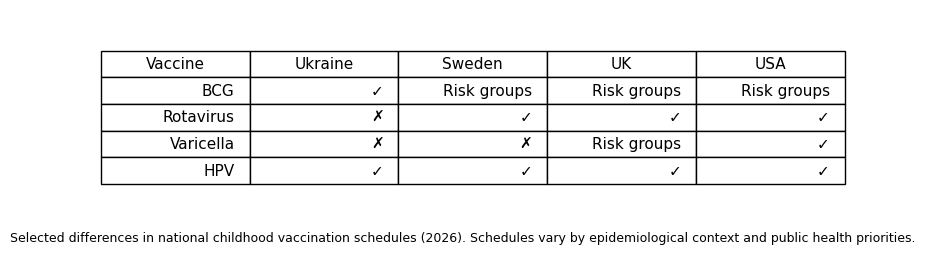
Why Vaccination Schedules Differ Between Countries
One thing that confused me as a parent was discovering that vaccination schedules are not identical everywhere.
Some countries vaccinate against certain diseases routinely, while others vaccinate only specific groups. This does not necessarily mean one country is right and another is wrong. Vaccination policies depend on local epidemiology, healthcare priorities, disease prevalence, costs, and public health strategies.
Take tuberculosis as an example. In countries where tuberculosis rates are relatively low, the BCG vaccine may not be part of the routine schedule for all children. In countries where tuberculosis remains a significant concern, BCG vaccination can still play an important role.
This is why it is normal to see differences between countries rather than a single universal schedule.
How Vaccine Safety Is Monitored
One of the most common fears surrounding vaccines concerns safety.
Vaccines undergo years of development, laboratory testing, clinical trials, regulatory review, and ongoing monitoring after approval. Safety surveillance does not stop once a vaccine reaches the market. National and international systems continue monitoring adverse events and investigating potential safety signals.
In Ukraine, vaccines supplied through national immunization programs have historically been procured with support from international organizations such as UNICEF and must meet international quality standards.
Parents also have the right to ask about:
- vaccine expiration dates;
- batch numbers;
- storage conditions;
- manufacturer information;
- possible side effects.
Asking questions is not anti-science. It is part of informed healthcare.
Side Effects: What Is Normal and What Is Rare
One reason vaccine discussions become so emotional is that side effects are real.
Most side effects are mild and temporary:
- pain at the injection site;
- redness or swelling;
- mild fever;
- fatigue;
- irritability in children.
Serious adverse reactions can occur, but they are rare. This is precisely why surveillance systems exist: to identify, investigate, and respond to potential safety concerns.
Acknowledging that vaccines can have side effects does not weaken the case for vaccination. In fact, transparency is essential for trust.
Measles and the Problem of Success
Many people today have never seen a child seriously ill with measles. That is largely because vaccination worked. Yet when vaccination rates drop, outbreaks return surprisingly quickly. Measles remains one of the most contagious diseases known to medicine. It can lead to pneumonia, brain inflammation, long-term neurological complications, and death, particularly among young children and vulnerable populations.
According to the World Health Organization, measles vaccination prevented tens of millions of deaths globally between 2000 and 2024. When vaccination coverage falls, outbreaks tend to follow. Measles
Why People Distrust Vaccines
Not all vaccine skepticism comes from ignorance. Sometimes it comes from low trust in institutions. People who have experienced corruption, poor healthcare systems, political manipulation, or medical negligence may naturally become suspicious.
The problem is that distrust can easily be exploited by misinformation. The internet allows rumors, anecdotes, and conspiracy theories to spread much faster than scientific evidence. A frightening personal story often feels more convincing than statistics, even when the statistics are much stronger evidence.
This is why vaccine discussions often become less about medicine and more about trust.
How I Look at Vaccination Today
Years ago, I approached this topic with much more certainty. Now I think the healthiest position lies somewhere between blind trust and reflexive skepticism. I do not think parents should accept every recommendation without asking questions. I also do not think internet rumors should outweigh decades of epidemiological research.Questions are healthy. Panic is not.
Vaccines are not magical. They are not flawless. They are not a cure for every problem. But they remain one of the most effective tools modern medicine has for preventing serious infectious diseases.
Perhaps the goal is not to become “pro-vaccine” or “anti-vaccine,” but to become better at distinguishing evidence from fear, uncertainty from certainty, and genuine medical concerns from misinformation.
Sources
- World Health Organization – Vaccines and Immunization
- World Health Organization – Vaccine Safety Questions and Answers
- World Health Organization – Measles Fact Sheet
- UNICEF – Immunization
- Centers for Disease Control and Prevention – Vaccine Safety
- European Centre for Disease Prevention and Control – Vaccines and Immunisation