
Breastfeeding is one of the best things that has ever happened to me. It took me about a month to get the process right, going through the awkward “getting used to it” stage, which is nothing compared to what both the baby and I gain from it.
Of course, not every woman can afford the luxury of being with her child all the time. The state and society we live in don’t make this easy. But providing a child with breast milk is a sacred task. Replacing it with formula takes away a child’s natural right and is a harsh interference with natural processes.
Breastfeeding Challenges
There is a mythical statistic that only 1–5% of women are unable to breastfeed. It’s convenient to use as an argument to support those who struggle to get into the process, but this statistic has no real basis: it is absolutely impossible to measure how many women can produce milk and why. The only path for each woman is to try: for some it comes easily, for others it requires considerable effort, and 99% of problems can be solved with the help of breastfeeding consultants.
Benefits of Breastfeeding
No statistics are needed to feel that breastfeeding is a natural and right process, beneficial not only for the child but also for the mother. Right after birth, breastfeeding helps stop bleeding, speeds up uterine recovery (my baby is already three months old, and I still sometimes feel my uterus contracting during feeds), aids weight loss, and reduces stress. In the long term, breastfeeding acts as a natural contraceptive (98% of women who breastfeed exclusively on demand do not become pregnant in the first six months, and sometimes even longer). It also reduces the risk of diabetes, cardiovascular disease, ovarian and breast cancer — and much more.
According to global statistics, only 38% of infants are exclusively breastfed. “Exclusively” means that the child receives only breast milk, without any additional liquids or complementary foods. The World Health Organization (WHO) recommends exclusive breastfeeding for the first six months, and from six months onward, the introduction of complementary foods alongside continued breastfeeding up to two years or longer.
And also, breasts are the best painkiller in the world. I urge mothers to do all painful procedures, like vaccinations, while the baby is at the breast. That is, offer the breast to the child, not use it for yourself. Take a sip of valerian for yourself.
Latching
For most people, breastfeeding begins in the maternity ward, where, unfortunately, the “old-school” approach still often prevails. If you’re not careful, they might not only interfere with the latch but even replace it with formula for no reason at all. Common myths s̶p̶r̶e̶a̶d̶ ̶b̶y̶ ̶w̶e̶l̶l̶-̶m̶e̶a̶n̶i̶n̶g̶ ̶b̶u̶t̶ ̶m̶i̶s̶i̶n̶f̶o̶r̶m̶e̶d̶ ̶w̶o̶m̶e̶n̶ — include “flat nipples,” “the baby isn’t getting enough,” “you must pump after every feed,” and so on. All of this is nonsense, and a full list of myths can be found here.
The worst thing that can happen to your breastfeeding journey is having uneducated people around + self-doubt. The most important principles for establishing breastfeeding and handling difficulties are: feeding on demand (or frequent latching in some cases), avoiding nonsense and bottles (if needed, expressed milk can be fed via a syringe, for example), and listening to no one blindly. If these three don’t help, find a lactation consultant — or become one yourself. (You can only become one after at least two years of actual breastfeeding experience.)
When a baby is born, they can clearly see only about 20–30 cm away — just the distance to the nipple, which the newborn perceives as a yellowish light at the end of a tunnel, with the familiar scent of amniotic fluid they’ve been in for months. In the first few days, the breasts produce colostrum, and a few drops are enough for the baby. By 3–4 days, transitional milk appears, and by about two weeks, mature milk is established.
The fourth trimester of pregnancy
These first few days are literally made for learning to latch. In general, the baby’s first three months are called the fourth trimester of pregnancy, a period when mother and baby get to know each other and learn to understand one another better.
Right after birth, a baby can be lethargic and sleep a lot. It is recommended to wake them at least every three hours for a feeding of about 20 minutes. This is partly necessary to kickstart the processes in your breasts. Later, under normal circumstances, the baby will start waking on their own or even signal hunger without fully waking, and you should feed them whenever you notice characteristic mouth movements, regardless of frequency. This is called feeding on demand. That said, I know women who didn’t wake their babies and simply let nature take its course, and everything turned out fine—so here, it really depends on the guidance of your maternal instincts.
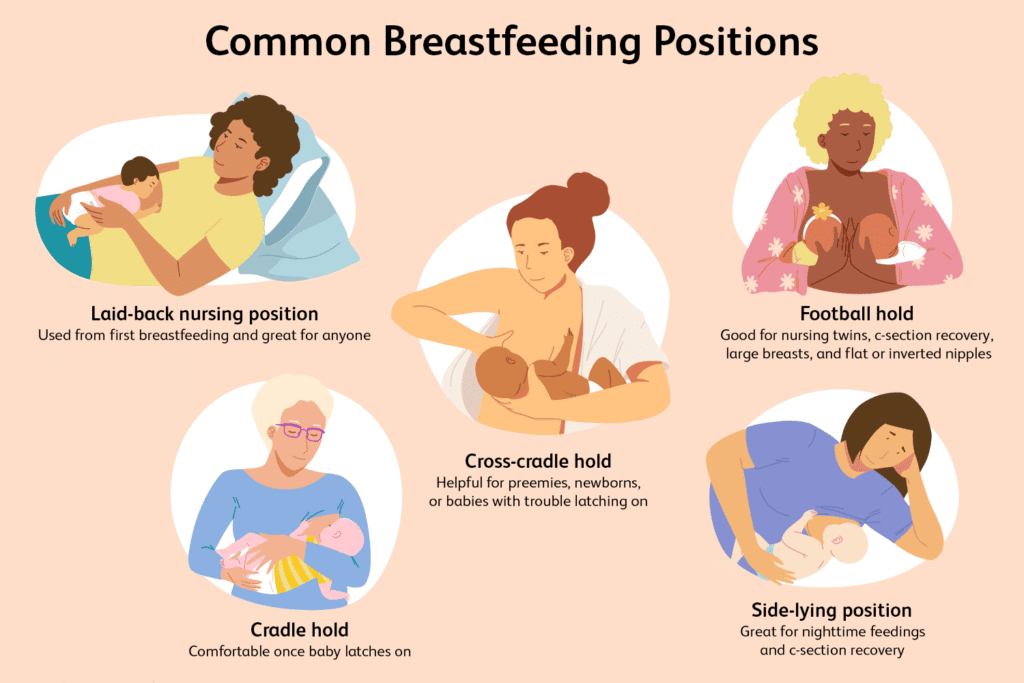
Feeding positions
There are no strict recommendations for breastfeeding positions; each woman adapts in her own way, finding what is comfortable for her. Here’s, in my opinion, the best selection of positions for feeding a newborn:
Contents and benefits of breast milk
Mother’s milk always adapts to the baby’s needs; for example, a premature infant receives milk with higher amounts of calcium and phosphates, essential for skeletal development.
Human milk is an extraordinary substance that cannot be synthetically reproduced. I was shocked to learn that the old “grandmother’s advice” to drop milk into the eyes actually makes sense. It has been proven that external use of breast milk is effective for:
- Atypical dermatitis (equivalent to 1% hydrocortisone ointment)
- Diaper dermatitis (equivalent to 1% hydrocortisone ointment)
- Neonatal conjunctivitis (equivalent to 0.5% erythromycin ointment)
I was also shocked to learn that many women consciously feed their babies formula, and that many doctors find the most fantastical, unsubstantiated reasons to advise against breastfeeding.
Most common breastfeeding problems
Nutrition and breastfeeding
There is no reason to deny yourself food while breastfeeding. After pregnancy, when I struggled to get even a bite down, the appetite that came after birth felt especially strong, but I took it as a blessing. Excess dough and sugar may affect your figure, that’s all, but there’s no reason to overindulge, whether you are breastfeeding or not. More about nutrition can be found here.
Medications
Sometimes you may be advised to stop breastfeeding due to supposed incompatibility with medications, without any real justification. Nonsense. The components of medicines and other products can be checked for compatibility on the excellent website e-lactancia, and you should ignore everything else except your child’s health.
I wish everyone enjoyment in breastfeeding and plenty of patience, which is sometimes demanded by those around you.