For a university course on intercultural communication, I recently wrote an essay on Hannah Arendt and the controversy surrounding her book Eichmann in Jerusalem. Hannah and her concept of the “banality of evil” fascinated me long before I studied her in depth, and later I became captivated by the idea of using this example to explore why we often fail to truly hear. I had previously tried to analyze this in the context of everyday communication, but at the time I lacked a theoretical framework.
Context
Eichmann in Jerusalem: A Report on the Banality of Evil (1963) remains one of the most debated texts of the 20th century. Reporting on the Jerusalem trial, Arendt described Eichmann as an ordinary bureaucrat whose cruelty stemmed not from fanaticism or sadism, but from an inability to think critically about the moral consequences of his actions — what she called the “banality of evil.” She also examined the role of individual Jewish councils in carrying out orders from the Nazi administration — a topic that contradicted the common perception of victims as entirely passive, sparking intense moral debate.
Two decades after the book’s publication, Irving Howe characterized the early 1960s as a “civil war” among New York intellectuals in response to Arendt’s work. Jewish intellectuals and organizations accused Arendt of coldness, arrogance, and lack of solidarity, while mainstream media critics accused her of misunderstanding the nature of evil and of inappropriate irony. Only a small portion of reviewers recognized the philosophical depth of her text; wider acknowledgment came later, mostly in the 1980s.
Eichmann as a Phenomenon, Not a Monster
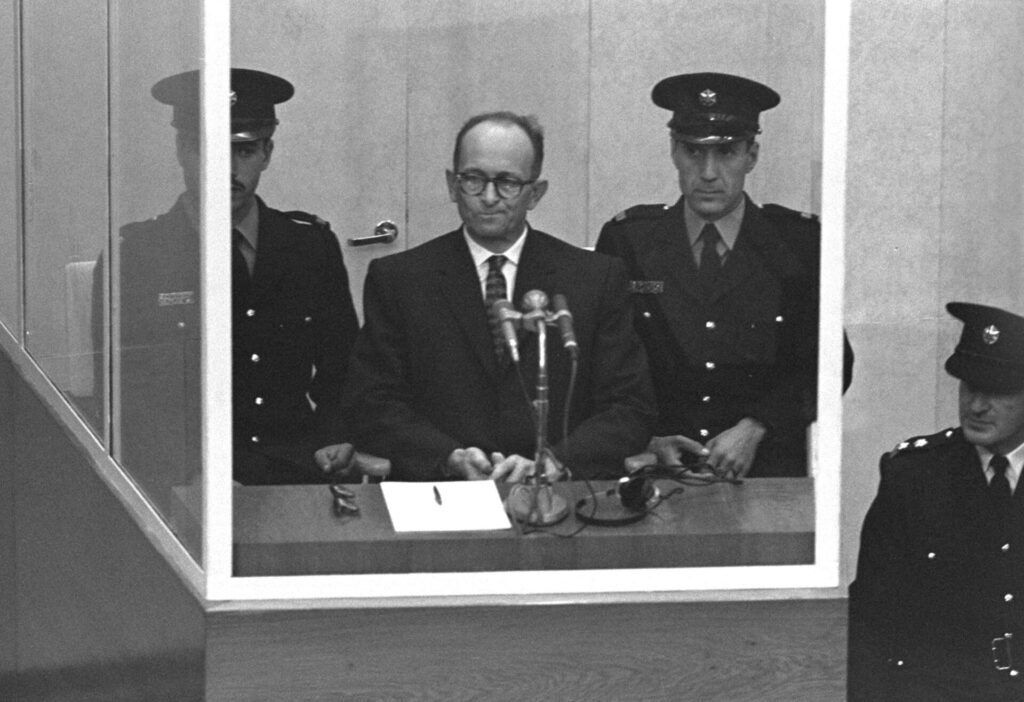
Contrary to public expectation, Arendt did not seek to demonize Eichmann. He appeared comically mediocre to her, with his bureaucratic clichés and pedantic compliance in court, despite the hopelessness of his situation. While she did not doubt that he deserved execution, this fact did not require discussion. Instead, Arendt approached Eichmann as a phenomenon — thoughtlessness, careerism, bureaucracy, mediocrity. He was a person who “simply did his job well,” — sending millions to their deaths.
Eichmann played a key role in the logistics of the Holocaust, overseeing the deportation of millions — mostly Jews, but also Roma, people with disabilities, political prisoners, homosexuals, Soviet POWs, Jehovah’s Witnesses, and other groups deemed “undesirable” by the Nazis. Arendt emphasized that this was not merely a crime against Jews, but a crime against humanity, stripping Jews of their status as “special.” The living embodiment of evil, the conscious killer, was suddenly revealed as an ordinary bureaucrat, and victims who were Jews became ordinary people — which many perceived as an attack.
“this case was built on what the Jews had suffered, not on what Eichmann had done“
— Hannah Arendt, Eichmann in Jerusalem: A Report on the Banality of Evil (1963)
Arendt described the courtroom and trial as a theater and a circus. People gathered not to judge the crimes of a single individual, but for a drama with Eichmann as Azazel. While emotions ran high, Arendt focused on observation and fact-gathering. She reported on these events in a series of New Yorker articles not from the perspective of a Holocaust victim, a Jew, or a judge, but from the perspective of a thinker — asking: what can this story teach us? What is it really about? How does evil work? What if each of us who refuses to think contributes to evil?
“The Banality of Reception”: Why We Hear Something Else Than What Is Said
Arendt offered the public something entirely unexpected. As a member of the Jewish community and a direct Holocaust survivor, she was expected to condemn Eichmann, highlight his monstrosity, and emphasize the suffering of the Jewish people. We would have call it the “banality of Arendt.” Instead, she spoke from a “third place,” as an independent thinker shaping meaning through writing, while maintaining her own identity, humor, and signature ironic tone.
This felt unacceptable, untimely, cold, and arrogant to many Jews. A betrayal of the community, a rejection of her own Jewishness, an affront — in short, everything it was not supposed to be. Close friends abandoned her, and the university where she taught attempted to expel her. Yet younger students, who had not directly experienced the Holocaust, were more open to objective thinking and remained on her side. Why did the older generation of critics fail to hear Arendt?
Kairos, Context, Trauma, Emotions, Expectations
Because critics interpreted her text not as a philosophical analysis but as an intrusion into a collective trauma that had not yet healed. For them, the Holocaust remained a living wound, not a historical fact, and any tone that did not match the expected emotional register — grief, solidarity, outrage — was perceived as cold or treacherous. Their cultural and emotional frames were shaped by survival, loss, and the struggle for memory. Within these frames, analyzing the crime as bureaucratic thoughtlessness sounded like a refusal to call evil evil. Criticism of the Jewish councils seemed an attack on the victims, and rejection of the national “we” appeared as delegitimization of a community seeking to restore dignity after catastrophe.
Kairos

The gap was this: Arendt spoke about the mechanisms of evil, but her critics heard judgment of the victims. She described a phenomenon, and they perceived it as a moral stance. Her analytical tone cut deeply because it did not match the ritualized, sacred way of processing tragedy necessary for Holocaust survivors or those who grew in its shadow. They did not fail to hear Arendt because she was wrong, but because they expected an entirely different language — the language of shared trauma, not of critical thinking.
Our habits, cultural lenses, emotions, and automatic associations can completely distort what we hear. People are not robots: a text always carries the identity of both the author and the reader, and both influence interpretation. Context and timing matter, too. Critics were responding not to Arendt’s text itself, but to their own expectations and interpretations.
Polarized Communication as Ground for Misunderstanding
Researcher Robert Arnett calls this polarized communication: when dialogue splits into two camps, each convinced of its own correctness and unable to consider that the other side may be right. As Arnett (1986) writes, the main problem of human community is communication in which
“there is an inability to consider one’s own position as false, or another’s as true; communication turns into rhetoric of ‘we are right, they are wrong.”
This is exactly what happened with Arendt. Her text was perceived not as analysis, but as taking the “wrong side”; not as philosophical reflection, but as a “wrong reaction.” Her work was read within a polarized framework — and therefore barely heard.
Narrative Frames and Collective Trauma
People rely on familiar, linear narratives: victim → perpetrator → justice → catharsis. Arendt’s position disrupted this sequence. She did not participate in the ritual of collective mourning and spoke not of “Jewish pain,” but of human cognitive emptiness, which leads to evil.
The context also played its role: less than twenty years had passed since the Holocaust, and the public still lived in trauma. The emotional register of the time demanded one tone from Arendt, but she chose another — a rational one.
Why This Is Relevant Now
Today’s information environment is very similar. We live in a time when emotional tone often matters more than content. Moreover, we (the Ukrainians) live not only in a post-traumatic era but in a moment when trauma is ongoing. Situations constantly arise in which someone is accused of “writing at the wrong time” or “writing in the wrong way”; where people react not to ideas, but to their own projections; where someone is criticized for discussing a topic deemed “irrelevant”, out of context, or emotionally inappropriate (“a joyful post on a day of mourning”).
This can be seen as an ethical issue, but at the same time, refusing to think and hear is itself the banality of reception: hearing only what is emotionally permitted, demanding the “right” register from others, confusing expectations with reality, responding not to the text but to one’s own assumptions about it, and telling others how they should behave.
How to Reduce the Banality of Reception
To avoid the effect of the banality of reception, it is important to practice mindful listening. This means trying to hear not only emotional signals, but also the factual content of what the speaker says, separating your expectations from the actual information. It is also helpful to examine your own assumptions and ask: what emotional or cultural filter is distorting my perception? If a discussion starts to adopt a “us vs. them” mentality, this is polarized thinking — false, because truth has many facets.
Active questioning helps clarify the meaning of the other’s words, for example: “What did you mean when you said ‘…’?” or “Did I understand your point correctly?” It is also important to refrain from automatic judgment and not respond immediately based on one’s own expectations, giving oneself time to reflect.
We cannot make others hear what we are actually saying
We cannot control other people’s triggers, experiences, histories, generational traumas, or expectations. The only thing under our control is to stop defining how others “should be” and focus on what we can do ourselves: speak as clearly as the situation allows; clarify meanings when they are distorted; avoid confusing our own emotional expectations with what was actually said. This does not guarantee understanding, but it creates space for it. The rest — the reader’s choice and responsibility — is as significant as the author’s.
Recognizing different communication styles helps navigate conversations: some people communicate analytically, others emotionally, and this does not make them “wrong.” After an interaction, reflecting on one’s own reaction and what influenced perception versus content is useful. Or one can simply argue, create conflict, and tell people how they should behave — the choice is ours.